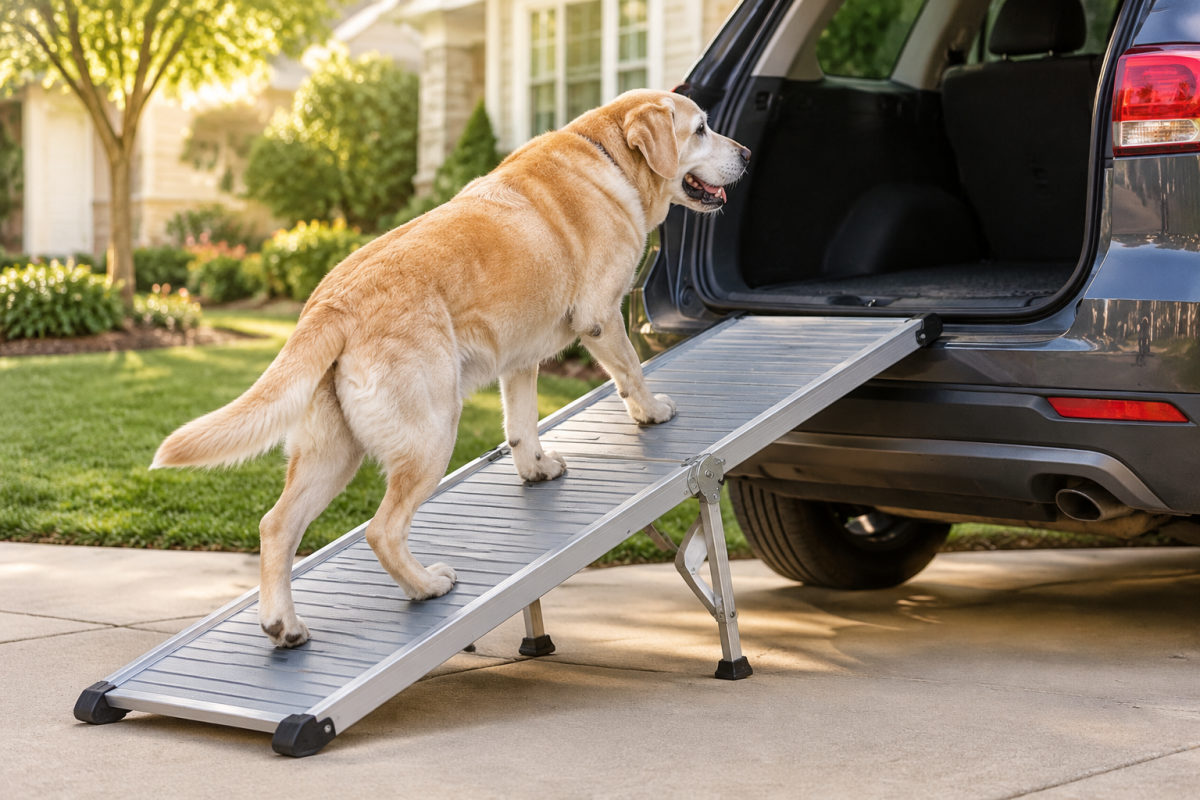
The grey muzzle is easy to notice. The way a dog starts living is harder to see: a half-second pause before the couch, a new wide berth around the stairs, sitting down hard instead of folding gently into the car. Senior dog mobility rarely fails all at once — it leaks away in a hundred small avoidances, and most of them are fixable without medication, without drama, and often without buying anything except a few habits.
This guide is about catching the leak early: what normal ageing looks like versus what needs a vet, how a ramp actually protects joints, how to pick one that a stubborn dog will accept, and the small changes around the house that keep an older dog doing the things they love. For the broader emotional side of an older dog's behaviour, our dog anxiety guide covers how pain and anxiety mimic each other — worth reading if the changes are mental as well as physical.
What normal ageing looks like — and what is not normal
Normal ageing in dogs is a slow movie: taking longer to stand up, sleeping deeper, losing some enthusiasm for the long walk, grey around the eyes. What you are looking for is hesitation, not inability — the dog still wants the couch, still wants the car, but negotiates with gravity first. That negotiating is your window: every pause is a joint saying "this costs me now."
The red flags are different. Sudden lameness, an obvious yelp, a swollen joint, refusing food with the movement change, dragging or scuffing toes, or a dog who suddenly cannot make it outside in time — those are not ageing, those are problems, and they belong in front of a vet. One more that owners miss: behaviour change counts as a movement symptom. A dog that has become grumpy when you touch their back, or anxious about stairs they used to fly, is usually telling you about pain, not personality.
Ramps versus stairs: the boring physics that protects joints
Every stair a dog climbs ends with them briefly supporting their whole body weight on two back legs while lifting the front pair — a compression spike through hips, knees and elbows. Repeat that twice a day for six years and you have built the exact load pattern that stiff senior joints hate. A ramp spreads the same height over a longer path: no landing impact, no spike, and — importantly for dogs whose muscles have thinned with age — no moment where they have to commit their weight to one small step.
The two jumps that matter most are not floors at all: the car and the sofa. The car is a jump of 45-70 cm — for a 10 kg dog that is proportionally like a human vaulting a fence — several times a week. The sofa is lower, but it is daily, joyful, and right next to the hardwood where slips happen. Eliminate those two jumps and you have removed most of the impact load in an older dog's life without changing anything else about it.
Choosing a ramp your dog will actually use
Four spec lines decide whether a ramp works or becomes furniture:
- Incline. Gentler beats shorter. Around 27 degrees or less for loading the car; closer to 18 degrees indoors if the dog is very stiff or very small. The real test: watch them come down. Freezing halfway means too steep; a downhill bolt means too easy to feel sketchy.
- Width. All four paws with room to spare. A Labrador on a narrow board feels the wobble and reads it as unsafe, regardless of surface. If your dog has ever fallen sideways off a step, width is your issue, not surface.
- Surface. Textured, high-friction, and clean. Grooved aluminum, heavy carpet, or rubber with a pattern all work; the failure mode is smooth plastic that polishes glossy after a month. Wipe the ramp weekly — paw wax and floor polish are silent killers of traction.
- Stability. Rubber feet that bite the floor, no bow in the middle under weight, no rocking. A ramp that moves underfoot once will be distrusted for weeks. For car ramps, folding side rails and a handle are worth paying for — a ramp that lives in the trunk gets used; one that lives behind the door does not.
For car and SUV loading, that shortlist is exactly what our folding aluminum ramp is built around: grooved non-slip deck, rubber corner feet, and a fold flat enough to live in the trunk year-round. For a fit check before buying, measure your bumper height and count out the four-inches-of-ramp-per-inch-of-height rule — the Extended size exists precisely because mid-size SUVs eat the smaller incline alive.
The five-session ramp training plan
Old dogs are not stubborn; they are evidence-based. They will not trust a surface they have not been paid on. Ten minutes a day, five sessions, no forcing:
- Session 1: ramp flat on the floor (no incline). Treats scattered along it. It is now a treat board, not an obstacle.
- Session 2: ramp raised to a low step height. Lure up with a treat at nose level, celebrate at the top, walk around to get back down. Never let them turn around or slide down.
- Session 3: full height against the actual car or sofa, engine off, you standing at the top. Three up-trips, huge reward at the destination, done.
- Session 4: one trip for real — into the car, treat, immediate exit. The car becomes a place you pass through on the way to good things, which quietly fixes two problems at once (if the travel itself is stressful too, the travel anxiety guide covers the rest).
- Session 5: normal routine. Your job now is only to keep rewarding at the top for a few weeks — the payment schedule can thin out, but it should never fully stop.
Two rules: never lift or shove a dog up a ramp (one panic-slide undoes a week of trust), and if the dog freezes, lower the bar — a session at half-height that ends in celebration beats a full-height stand-off every time.
The joint-friendly house: five changes bigger than the ramp
1. Traction on the slip zones. Hardwood and tile are the enemy of thinning muscle. Runners or matte mats down the main routes — especially the corner a dog always drifts wide — cost less than one vet visit and prevent the splay-step that slowly wrecks shoulders.
2. Food and water where the neck already is. A raised stand or simply a mat that keeps the bowls from skating takes the compression out of every meal two to three times a day. Our silicone bowl mat with its raised lip stops the sliding, and the bowl mat guide covers sizing for older dogs' posture.
3. Bed at the destination, not the journey. A supportive bed placed within one step of where the dog wants to be (the living room floor, not the upstairs crate) removes the hardest climb of the day. If the destination is the sofa, a two-step pet stair plus a ramp for the car is a legitimate combination.
4. Shorten, do not stop, walks. Older dogs need movement daily and intensity rarely. Two shorter, sniffy walks beat one long march; keep the route familiar — a stiff dog on a new trail is a cautious dog on unknown footing.
5. Keep the nose working. Mobility limits the body, not the brain. A snuffle mat or frozen lick mat delivers a full day's mental work in ten minutes on flat ground — the single best quality-of-life tool for a dog whose legs have caught up to their age.
When it needs a vet, not a product
Buy the ramp for the dog who hesitates and still goes. Take to the vet the dog who has stopped going. Specifically: sudden loss of movement or a changed gait, yelping or flinching when touched, joints visibly warm or swollen, struggling to stand after sleep more than a few seconds, accidents from not reaching the door in time, or hiding behaviour. Arthritis in dogs is enormously manageable — weight, physical therapy, and modern pain plans change the last third of a dog's life — but management starts with a diagnosis. "She's just old" is the most expensive sentence in senior dog care. Everything in this guide works best as the supporting cast around a vet-approved plan, not instead of one.
Common questions
Are ramps better than stairs for senior dogs?
For most older dogs with stiff joints, yes — a ramp spreads the same height gain over more steps' worth of effort, so the knees and hips never take the full-body compression a stair step demands. Stairs still beat jumping, but a ramp with a gentle incline is the lowest-impact option, especially for the two places that matter most: the car and the sofa.
What incline should a dog ramp have?
Gentler is almost always better. A common guideline is around 27 degrees or less for car-loading ramps and closer to 18 degrees for indoor ramps if your dog is very stiff or tiny. The practical test beats any protractor: set the ramp up, watch the dog come down. If they bolt down it, the incline is too easy to feel risky; if they freeze halfway, it is too steep. Adjust the length, not the dog.
How do I get my old dog to use a ramp?
Five short sessions, high-value treats, zero forcing: ramp in place, treat near the base; treat at the middle; treat at the top; full trip with you at the top; full trip with the real destination (the car seat, the sofa). Most confident dogs are loading the car within a week. Never lift or push a dog up the ramp — one bad slide undoes five good sessions.
What size ramp does my dog need?
Two numbers decide it. Length: the ramp needs to run long enough for a gentle angle — plan on roughly four inches of ramp for every inch of height. Width: your dog should be able to put all four paws on it with room to spare; a Labrador on a walk-board width will feel the wobble and refuse it, no matter how good the surface is.
Is it just old age, or does my dog need a vet?
"Just old age" is not a diagnosis. Sudden lameness, visible pain yelps, swelling, refusing to go up or down at all, accidents from not reaching the door in time, or personality change (a gentle dog snapping when touched) all deserve a vet visit — arthritis is manageable but it starts with a proper diagnosis and a pain plan. Ramps and traction help a comfortable dog stay comfortable; they are not treatment for an uncomfortable one.
Recommended Gear: Folding Aluminum Pet Ramp — Car & SUV Loader
The jump your senior dog can't make anymore, replaced with a 15° ramp instead of a 90° leap.