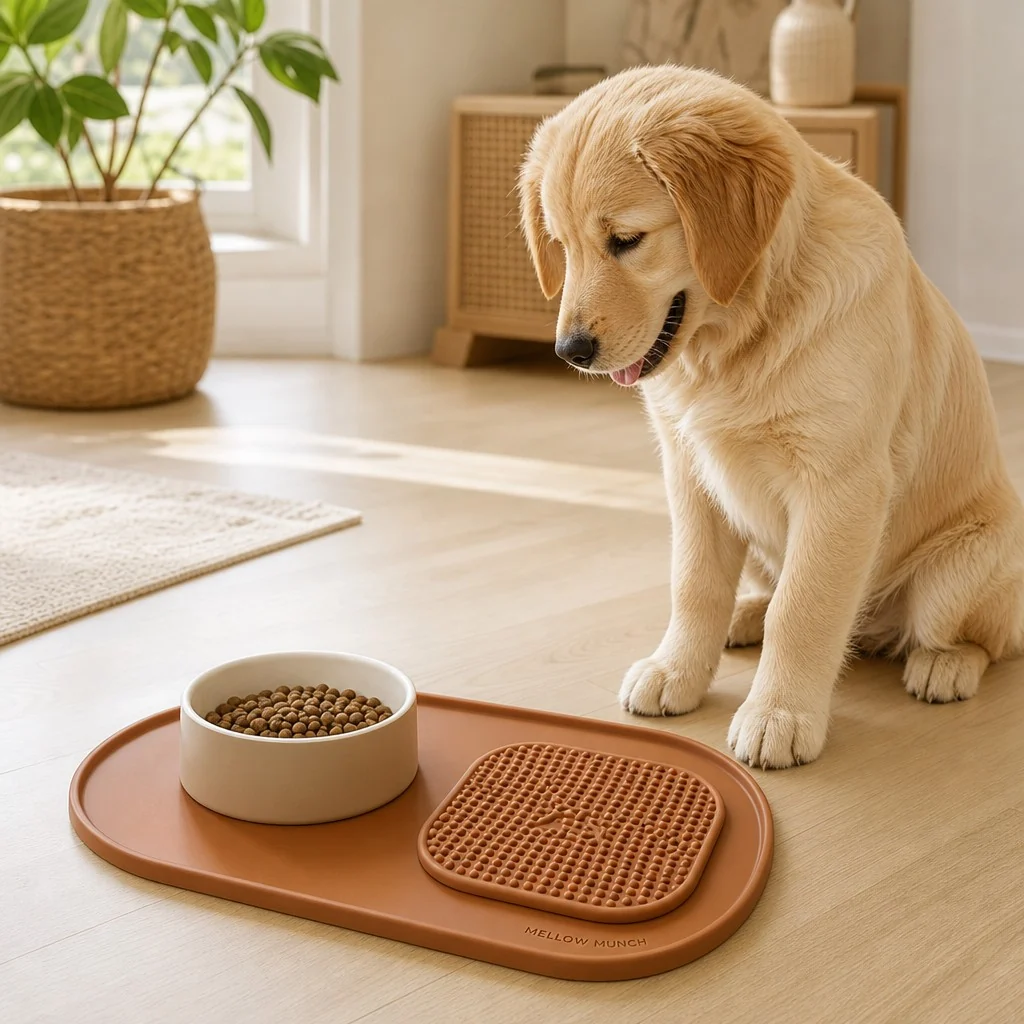
Ask ten dog owners what they are least happy about at the feeding station and most will say the same thing: the mess. Kibble tracked three metres down the hallway, a tide line of water around the bowl, a hardwood floor that slowly stains no matter how often it is wiped. A bowl mat is the cheapest fix for all of it — and it is also the easiest product to buy badly, because "mat" covers everything from a thin fabric square to a deep silicone tray. This is what a bowl mat actually does, the three form factors compared, and how to size and choose one so it solves the problem instead of just sitting under the bowl.
What a dog bowl mat actually does
Four jobs, in rough order of how often you notice them:
- Contain the spill at the source. Water from a fast drinker and kibble from a sloppy eater land on the mat instead of the floor. The mat becomes the only thing you clean.
- Protect the floor. Hardwood takes permanent water rings. Tile grout takes coffee-coloured stains. Sliding bowls scratch both. A mat with a non-slip base stops the bowl from moving at all, which removes a share of the spill before it happens.
- Cut the cleanup cycle. Wiping one mat is a five-second task. Vacuuming kibble out of carpet and mopping a water ring is a fifteen-minute task you do several times a day.
- Keep the feeding spot in one place. This sounds trivial until the dog has learned that the bowl moves wherever the owner is standing. A heavy mat anchors the station.
The three form factors, compared honestly
Raised-edge silicone mat. A flat silicone pad with a raised rim — our 19" x 12" mat works on this principle. The rim catches liquid spills, and the non-porous surface wipes clean in seconds. The honest limitation: it only contains what falls inside the rim. A dog that hurls water outward will still get a few droplets past the edge.
Flat mat (silicone, rubber, or fabric). No rim; the whole footprint is the catch area. If the mat is big enough, nothing inside it escapes — but "big enough" is where most flat mats fail. Water and kibble that land within an inch of the edge are on your floor. Flat mats suit dry-food scatter messes better than liquid ones.
Washable fabric pad. Microfibre or terry cloth, machine washable, soft under paws. The honest limitations: fabric absorbs, so a wet fabric pad stays damp, and damp fabric in a food zone holds odour and can mildew if it does not dry fully. Fabric pads also wear down fastest under daily paw traffic. They are the right choice for a light-spiller dog in a household that likes soft textures — not the right choice for a heavy water drinker.
Materials: silicone vs rubber vs fabric
| Food-grade silicone | TPE / rubber | Fabric | |
|---|---|---|---|
| Cleaning | Wipe, rinse, or dishwasher (top rack) | Wash; can trap fine grit | Machine wash |
| Odour retention | None — non-porous | Moderate, builds over months | High if not fully dried |
| Waterproof | Yes | Yes | No — absorbs |
| Lifespan (daily use) | Many months to a year | Months; surface hardens | Shortest; frays at edges |
| Watch for | Must be BPA/PVC/phthalate-free; not a chew toy | Cheap versions off-gas a plastic smell | Mildew if stored damp |
For a feeding station that sees water every day, non-porous wins. If you buy silicone, check the spec for food-grade certification and that it is free of BPA, PVC and phthalates — the same standard a bowl should meet, because food and water sit on it all day. And the same rule as with any silicone pet product: it is a surface, not a toy. A dog that chews it off in pieces can swallow them, so if yours starts treating the mat like a chew, rotate to a different enrichment tool.
Sizing: the most common mistake is buying small
Work backwards from the setup, not from the bowl. Two rules that cover almost every case:
- Single bowl: bowl diameter plus roughly 15 cm of margin on every side. The spill happens at the edge of the bowl, and the mat has to be past that.
- Two bowls side by side (food + water): a rectangle that covers both bowls plus the gap between them plus margin. A 19" x 12" mat is sized for exactly this — two standard bowls, or one slow-feeder bowl plus a water bowl.
If the bowl sits on a raised stand, measure the stand's footprint, not the bowl — and the mat has to be larger than that rectangle, or it will simply slide out from under the stand the first time the bowl is bumped.
Cleaning and when to replace it
After each meal: rinse food scraps off. Weekly: a proper wash — silicone goes in the dishwasher top rack or gets a soap-and-hot-water scrub; fabric goes in the machine. Dry it flat before the next meal; a mat that dries overnight is fine, one that sits in a food zone damp for days will start to smell.
Replace the mat when a smell survives a wash, when you can see tears or thinning in the surface, or when the non-slip base has worn smooth and the mat drifts under the bowl. A well-made silicone mat in daily use typically lasts many months; a fabric pad in the same spot lasts a fraction of that.
Where a bowl mat fits the rest of the feeding setup
It is not a standalone fix — it is the base layer. Under a slow feeder bowl it catches the kibble the maze scatters, which is where the combination earns its keep. Next to a lick mat station it keeps the floor dry while the dog works the mat. With a raised stand it stops the whole assembly from migrating across the floor.
And for anyone stocking a feeding range rather than one: the mat is the natural attach item — light, flat, ships in a box, and it solves the exact complaint most customers arrive with. Wholesale pricing on the full feeding line is here.
Frequently asked questions
Do I need a dog bowl mat if my dog only eats dry food?
Yes, though the mess it solves is a different one. Dry-food dogs make crumb messes: kibble scattered by the maze bowl, crumbs tracked in paw prints, and a water bowl that still produces liquid. Dry food changes the kind of cleanup, not whether you need one.
Will a mat fit under a raised bowl stand?
Only if it is larger than the stand's footprint. Measure the base rectangle of the stand — not the bowls — and buy a mat that covers it with margin to spare. A mat sized to the bowls will slide out from under the stand at the first bump.
Are silicone bowl mats safe for dogs?
Food-grade silicone — free of BPA, PVC and phthalates — is safe for a dog to stand and eat over. It is a surface, not a chew toy: a dog that tears off pieces can swallow them, so supervise early uses and rotate to another tool if the mat itself becomes a chewing target.
Does a bowl mat stop a fast drinker from splashing?
It contains most of the spill at the source, but a determined splash will clear a raised edge now and then. If splashing is the main problem, a smaller or lipped water bowl does more than a bigger mat — use the mat to catch what still gets out.
How often should I replace a bowl mat?
When a smell survives a proper wash, when the surface shows tears or thinning, or when the non-slip base has worn smooth. A well-made silicone mat in daily use lasts many months; fabric pads in the same spot last a fraction of that.
Why do pet retailers stock bowl mats?
Because it is the cheapest accessory that solves the complaint most customers bring into the store: the mess at the bowl. It is flat, light, ships in a standard box, and it attaches naturally to every bowl, slow feeder and raised stand already on the shelf.
Recommended Gear: Waterproof Dog Bowl Mat — Raised-Edge Silicone Placemat
0.8cm raised spill-proof edge traps kibble and water spills. 100% food-grade silicone with non-slip grip.