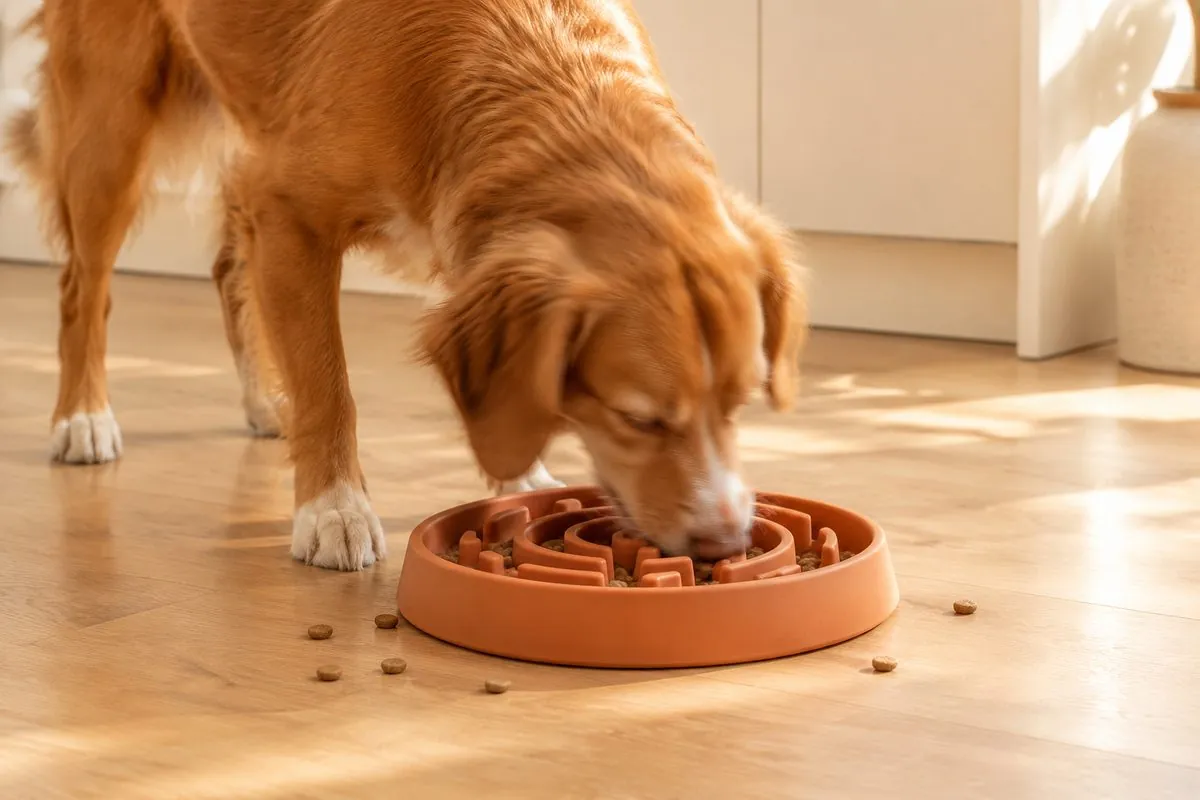
Almost nobody asks this question because their dog is hungry. A dog that inhales a bowl in twenty seconds and then looks up for more is usually not starving - it is doing something it learned, reinforced by the fact that eating fast feels good. The useful question is not "why" but "which of the four reasons is it, and does it matter enough to change anything".
Reason 1: competition history
Dogs that were fed in a litter, in a shelter, or alongside another dog learned that food disappears if you are slow. That learning does not expire when the competition does. It is the single most common reason a well-fed dog still eats like someone is about to take the bowl away - and it is why a dog that eats fast often also guards the bowl.
Reason 2: the food is too palatable for the job
Highly scented kibble and wet food trigger fast eating the same way a bag of crisps does in humans - the reward is immediate and the food takes no effort. This is why some dogs eat one brand in thirty seconds and pick at another. It is not a defect in the dog; it is a mismatch between how attractive the food is and how much chewing it requires.
Reason 3: the schedule has gaps in it
One large meal a day, or a long gap between dinner and breakfast, produces a genuinely hungry dog by the time the bowl lands. Puppies and small breeds in particular do better on three or four smaller meals. Before buying anything, count the hours between meals - if the answer is "sixteen", the speed is a symptom, not the problem.
Reason 4: it is just habit, and it is self-reinforcing
Fast eating is rewarded by fast eating: the quicker the meal, the sooner the dog is free to do something else, and the more the behaviour is practised. This is the reason a bowl change alone often fails - the habit is about the routine around the meal, not only the bowl.
Why speed matters at all
Three concrete costs, in ascending order of seriousness.
Swallowed air. Fast eaters gulp air with the food, which shows up as hiccups, burping, and occasionally bringing the meal back up within minutes. Unpleasant, rarely dangerous.
Vomiting after meals. A stomach that fills faster than it can signal fullness tends to return the excess. If your dog vomits undigested food shortly after eating and then wants to eat again, speed is a reasonable first suspect.
Bloat (GDV). For large and deep-chested breeds this is the one that matters. Rapid eating and air swallowing are among the factors discussed in relation to gastric dilatation-volvulus, which is a surgical emergency. Learn the signs - unproductive retching, a hard distended abdomen, restlessness, drooling - and treat them as a vet visit right now, not tomorrow. No bowl prevents this; it only removes one avoidable contributor.
The 60-second test
Before changing anything, measure. Time three meals with your phone, same food, same portion. Under sixty seconds on average means fast; under thirty is very fast. Then change one thing - the bowl - and time three more. If the number does not move, the cause was the schedule or the food, not the delivery.
What actually slows a dog down
Surface area. This is the whole mechanism. Every maze wall, ridge and pocket adds distance between mouthfuls. A maze slow feeder does it in a bowl; a lick mat does it with texture and wet food. If you want the full comparison of bowl patterns and materials, which slow feeder actually works covers it.
Obstacles, not gimmicks. A wide shallow maze beats a deep narrow one for most dogs, because the dog can reach every part of it. Deep channels look impressive and get abandoned.
Smaller, more frequent meals. Free, and often more effective than any product. Splitting the daily ration in three takes the edge off meal-time urgency.
Wet food on a textured surface. Licking is slow by nature - a thin smear takes minutes where a bowl takes seconds. The mechanics are in how to use a lick mat.
What does not work: bigger bowls (more food, same speed), raised bowls for speed (they change posture, not pace), and objects dropped in the bowl - a real choking and tooth-injury risk.
The honest limit
A slow feeder turns a thirty-second meal into five to ten minutes. It does not fix a schedule with a sixteen-hour gap, it does not make a competitive eater relax, and it is not a treatment for vomiting or bloat risk. If your dog is losing weight, regurgitating regularly, or eating non-food items, that is a vet conversation - and if you want to work on the underlying restlessness rather than just the speed, the enrichment system is the better starting point.
Common questions
How fast is too fast for a dog to eat?
A useful rule of thumb: a meal that disappears in under a minute is fast, and under thirty seconds is very fast. The test is simple - time three meals with a stopwatch, no changes to anything else. If the average is under 60 seconds, the dog is eating fast enough to swallow air, and a slow feeder is worth trying before anything else.
Is fast eating actually dangerous?
For most dogs it means swallowed air, hiccups and occasional vomiting right after meals. For large, deep-chested breeds it matters more, because rapid eating and air swallowing are discussed as risk factors for bloat (GDV) - a genuine emergency. Unproductive retching, a visibly swollen abdomen, restlessness or a dog that cannot settle after eating needs a vet immediately, not a bowl change.
Do tennis balls or rocks in the bowl work?
They are the most common DIY advice and the worst: a dog can get a jaw or tooth caught, and small dogs can swallow them. If you want a free version, scatter the kibble across a baking tray or the floor instead - surface area slows eating without adding a choking hazard.
Does a slow feeder work with wet food?
Yes, with one adjustment: wet food in a deep maze dries and becomes hard to lick out, so either thin it with a little water or use a shallower maze. Most owners end up using the bowl for kibble and a lick mat for wet food - the two together cover both textures.
My dog gets frustrated and flips the bowl. What then?
That is usually a difficulty jump, not stubbornness. Start with a shallow pattern, sprinkle a few pieces of something high-value on top so the first win is instant, and feed when the dog is calm rather than starving. If the dog still gives up after three tries, the maze is too deep for the muzzle - a flat lick mat is the better first step.
Recommended Gear: Slow Feeder Bowl for Dogs — Anti-Gulp Maze
Your dog doesn't need a faster bowl. They need a slower one. The maze pattern forces a proper eating pace.