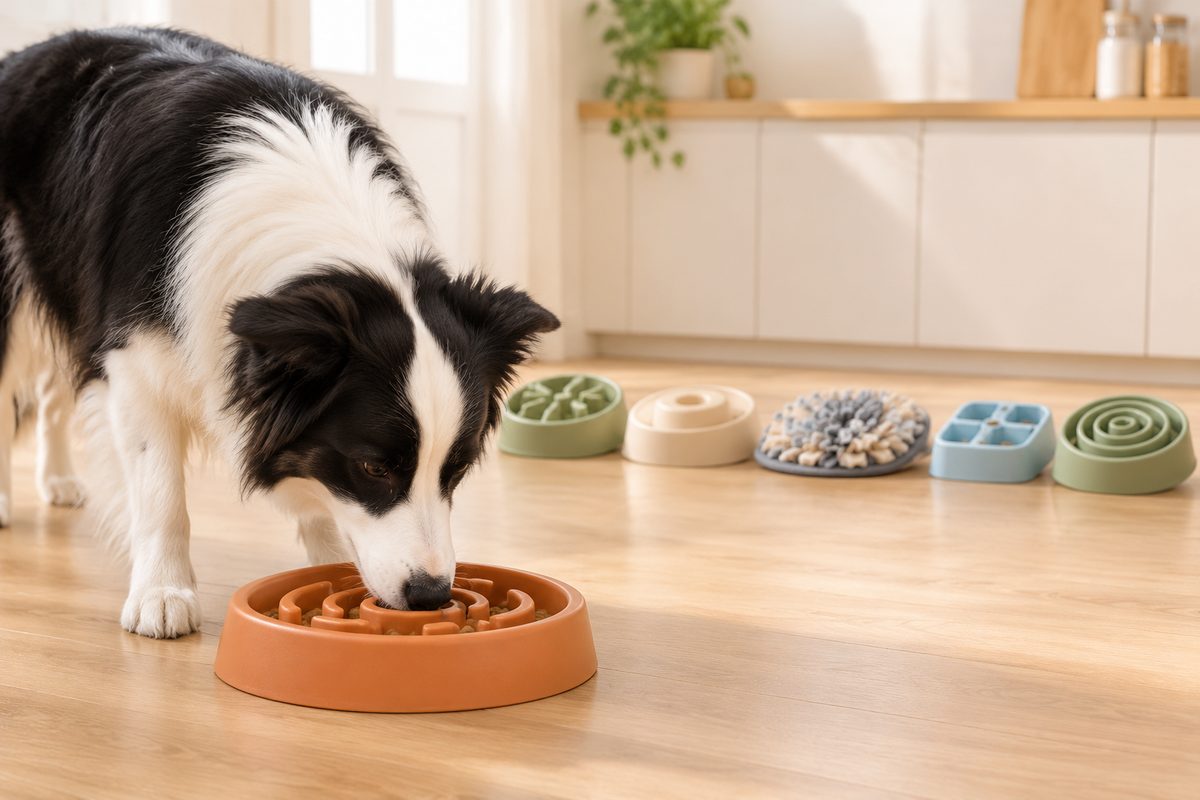
Search "best slow feeder dog bowl" and you'll get a dozen listicles ranking bowls none of the authors have watched a dog eat from. Full disclosure up front: we design and wholesale a maze bowl, so we are not an impartial party. What we are is unusually qualified — we've had this bowl eaten out of by fast-eaters of every size, and we have no interest in recommending a style that fails the dog who buys it. Here is the honest physics of all five slow-feeder types, ranked by where each one wins and loses.
First, what actually slows a dog down
Dogs that inhale food aren't choosing speed; they're running a foraging program that pays for fast hands in a competitive litter. A slow feeder works by inserting obstacles between tongue and kibble — there are only three mechanisms available: break the surface into pockets (maze), tilt the surface away (raised curve), or move the food (puzzle, snuffle). Everything else is marketing. Which mechanism wins depends entirely on your dog's size, muzzle length, and how stubborn they are about novelty.
The five types, honestly ranked
1. Maze bowls (9/10 for most dogs): a snaking groove pattern spreads a single cup of kibble across the whole surface, so the dog works pockets one at a time. Best all-round slowdown per dollar, dishwasher-safe, works with wet toppers, and flat enough for short muzzles. Loses to nothing except deep-pocket designs that trap food for flat-faced dogs. This is the style we make; if you want the material argument done properly, the slow feeder bowl materials guide covers silicone vs plastic vs ceramic in depth.
2. Raised-curve / donut bowls (8/10 for big dogs): a dome in the middle forces a large dog's wide tongue to circle it, kibble pinned at the rim. Excellent for Labradors, Goldens and other broad-tongued breeds that "read" a maze as an open buffet. The honest downsides: small dogs can't reach the rim ring, and the underside is a kibble trap between repasts unless it's one piece.
3. Snuffle mats (7/10, different job): hiding kibble in fabric strips slows dinner with the nose and burns real mental energy — 10 minutes of nosing equals a long walk's worth of calming. But it isn't a bowl: washing and drying a fleece mat weekly is a chore people quit, and a mat used for every meal stays damp. Best as a rotation piece, not the primary. Full breakdown in our snuffle mat guide.
4. Puzzle feeders with moving parts (5/10): flip-trays and sliding compartments genuinely engage bright dogs — and genuinely frustrate the average one. Frustration at 6pm is not what mealtime should be. Also: every moving part is a mold trap or a chew shrapnel risk. Reserve for dogs who've beaten every other option.
5. Ridge / spiral-hill bowls (4/10): the classic concentric circles. They slow vacuum-eaters a little, but the ridges are usually too shallow for medium muzzles and too tight to clean for wet food. If dinner includes anything moist, skip this style entirely.
Matching the bowl to the dog
The nine-second wolf: maze bowl, today. The change is visible on night one. Deep-chested giant (Great Dane, Shepherd, Setter): raised-curve at floor height on a stand; pair it with the behavioral levers in our bloat-risk guide — the bowl handles pace, not anatomy. Flat face (Pug, Frenchie, Boxer): shallow maze with low walls, or a suction lick mat instead — spread, freeze, done; deep pockets are physically cruel to a square muzzle. The negotiator who paws food out of bowls: none of the above survive a creative Lab — use a maze bowl stuck to a gripped silicone splash mat so the "game" becomes part of the meal.
The cleaning trap — why slow feeders get abandoned
Nobody quits a slow feeder because it doesn't work. People quit because on week three, a dried smear of wet food has cemented itself into every corner of a cheap bowl and they're scrubbing maze pockets with a toothbrush at the sink. This is a materials failure, not a concept failure: rigid plastic micro-scratches and holds odor, ceramic glaze is fine but shatters, and one-piece food-grade silicone rinses clean under hot water in ten seconds and runs the dishwasher without ceremony. If your bowl requires a dedicated brush, your dog will be back to a regular bowl by Christmas — buy the boring-to-clean one.
The two-minute transition
Fast eaters can find a new bowl suspicious. Three moves make the switch stick: run the first few dinners with a slightly reduced portion in the new bowl plus one teaspoon of something smelly in the deepest groove; keep the old bowl put away, not beside it (a faster option on the floor is a decision you've handed back to the dog); and go back to full portions once dinner reliably lasts three minutes. If your dog genuinely ignores a maze bowl, that's usually a size or wall-height mismatch — go one style down the list, not one price point up.
The short answer
For the majority of dogs — medium muzzle, kibble-plus-topper diet, dishwasher available — the best slow feeder dog bowl is a one-piece food-grade silicone maze bowl: the strongest slowdown-per-dollar in the category, and the only style that survives years of wet food without becoming a hygiene project. That's precisely why it's the bowl we make; the maze slow feeder ships at $17.99, boxed with two lick mats in the Holiday Calm Kit if the kitchen needs the full calm-meal stack. If your dog falls into the deep-chested or flat-faced camps above, follow the honest alternative for their anatomy instead — a bowl that fits the dog beats a bowl that fits an article.
Common questions
Do slow feeder bowls help prevent bloat?
No study proves a bowl prevents GDV (bloat) — anyone claiming that is selling something. What slow feeders demonstrably do is end the gulping race that causes regurgitation, gas and the frantic re-eating of what came back up. The real bloat levers are separate: no hard exercise around meals, smaller frequent portions, and knowing your deep-chested breed's risk. Our bloat guide covers that layer.
How slow should eating actually be?
Aim for 3-5 minutes on dry kibble. Under one minute means the bowl isn't slowing anything; over ten usually means the puzzle is so hard the dog gives up and whines at you instead. The right bowl makes mealtime a foraging task, not an IQ test — you should be able to watch them solve it, not watch them lose it.
Can I use a slow feeder bowl for wet food or a topper?
Yes on maze and curve styles — the same pockets that trap kibble hold a smear of wet food or pumpkin just fine, and a silicone bowl rinses clean in seconds. Ridge bowls with tight, shallow ridges are the ones to avoid for anything moist. Freezing a topper layer in a maze bowl turns dinner into a twenty-minute event for storm nights.
Are plastic slow feeder bowls bad?
The problem isn't the word plastic, it's cheap polypropylene that gets chewed into shards by determined dogs and micro-scratches that harbor bacteria over time. Hard polycarbonate puzzle parts and ceramic glaze are fine for most dogs; the reason we build ours from food-grade silicone is a different argument — no clatter, no floor slides, and dishwasher honesty. See the materials deep-dive for the full comparison.
Will a slow feeder bowl work for a cat?
Maze bowls are too tall for most cats' faces; flat lick mats and low-profile puzzle plates work far better. Cats eating too fast is usually solved by portioning into several micro-meals (an timed feeder) plus a shallow wide dish — the slow-feeder logic applies, the dog-shaped hardware mostly doesn't.
Recommended Gear: Slow Feeder Bowl for Dogs — Anti-Gulp Maze
Your dog doesn't need a faster bowl. They need a slower one. The maze pattern forces a proper eating pace.