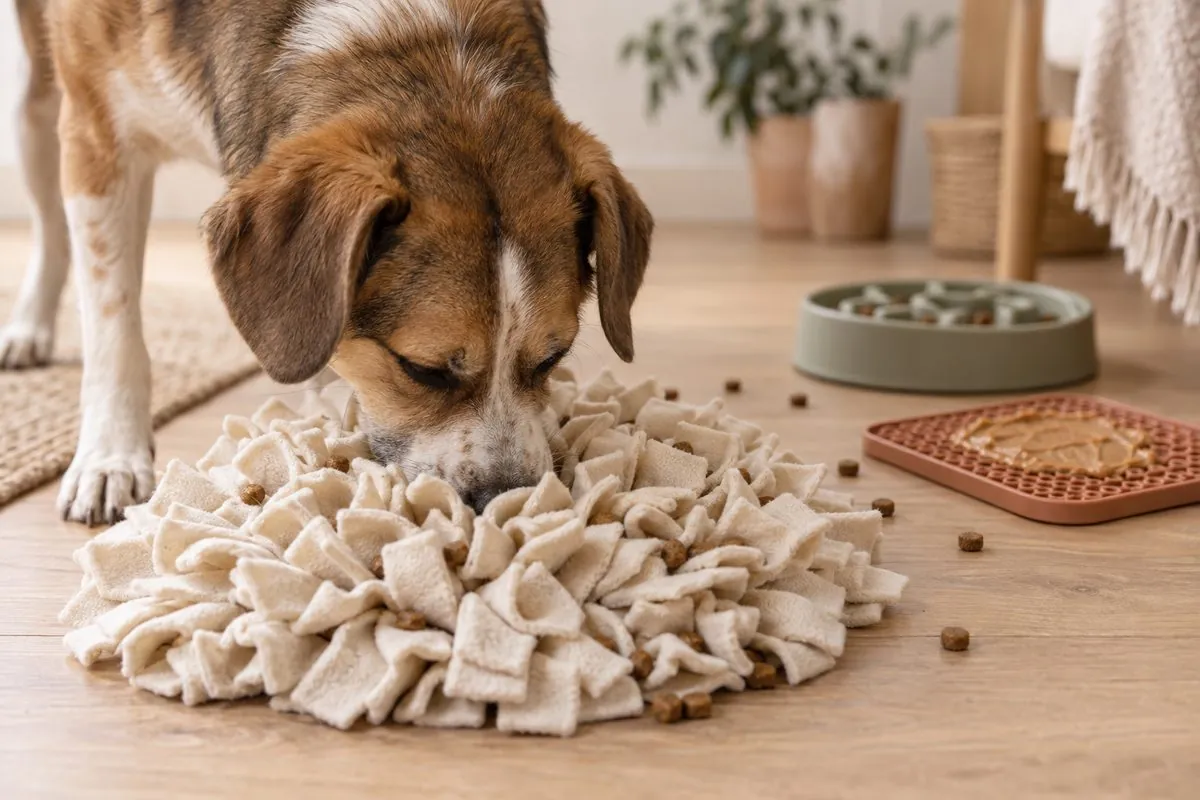
Most dogs are not under-exercised. They are under-employed. A border collie that walks nine kilometres a day and still eats the sofa is not short of steps - it is short of work that uses the part of the brain it was bred for. Enrichment is the fix, but the version sold in pet shops is usually a bin of toys, which is why it stops working after a week.
Three buckets, not a toy box
Every enrichment activity a dog actually values runs through one of three channels, and they are not interchangeable:
Nose. Scent work is the highest-value currency for a domestic dog, because smelling is how dogs read the world. Snuffle mats, scatter feeding and "find it" games all sit here.
Mouth. Chewing is self-soothing and jaw work at once. Natural rubber chews and frozen lick mats cover this bucket; both also buy you twenty quiet minutes.
Brain. Problem-solving - maze bowls, shaping games, puzzle feeders - is what most "enrichment" marketing actually sells, and it is the bucket most easily over-engineered.
The reason a toy box fails is novelty decay. A new toy is interesting for about three days; after that it is furniture. Rotation beats accumulation, which is why the schedule below recycles the same handful of items.
The five-minute daily system
One bucket per day, five to fifteen minutes, done properly. That is the whole system.
Monday - nose. A third of the day's kibble into a snuffle mat, or scattered across a lawn if the weather allows. Ten minutes of sniffing does more than a bored lap of the block.
Tuesday - mouth. A natural rubber chew while you have your coffee. Do not hover; the point is independent work.
Wednesday - lick. Frozen lick mat with wet food or plain yoghurt if your dog tolerates dairy. This is the calming bucket - licking lowers arousal, which is why it works before a vet visit or during a storm. The mechanics are in how to use a lick mat.
Thursday - brain. A slow feeder dinner, or a shaping game: reward the dog for looking at a cardboard box, then touching it, then standing in it. Two minutes of shaping teaches more than twenty minutes of fetch.
Friday - nose again, harder. Hide five pieces of kibble around one room. Let the dog watch you hide two of them, then send them out of the room for the rest.
Saturday - decompression walk. Half the distance, four times the sniffing. A long line and no destination. This is the single most under-rated enrichment activity and it is free.
Sunday - nothing. Dogs need to be bored sometimes, or the baseline resets to "entertained" and everything you offer looks dull by comparison.
What to buy, what to make out of rubbish
Be honest about which half of this is shopping and which half is not.
Worth buying: anything that has to survive daily washing and a determined jaw - a snuffle mat with a sewn base, food-grade silicone lick mats, a weighted slow feeder. These are durability purchases.
Make it yourself: scatter feeding, "find it", cardboard-box shaping, muffin-tin puzzles with tennis balls over the cups, a towel rolled with kibble inside. Free, and the dog cannot tell the difference.
If you want the minimum viable kit that covers all three buckets, it is three items: one nose item, one mouth item, one brain item. Everything else is a variation on those.
Enrichment is not behaviour modification
This is where most advice quietly lies. Enrichment lowers baseline boredom and gives an outlet for normal dog behaviour. It does not treat:
Reactivity on lead, which is an emotional response needing distance and systematic desensitisation - see what actually helps an anxious dog.
Separation anxiety, which is panic, not boredom. A frozen mat at the door is management, not treatment.
Resource guarding, which gets worse if you add high-value food items without a plan.
And a sudden change in behaviour is a medical question before it is a training one. Destruction that starts at 18 months, night pacing, or a dog that stops eating is a vet appointment, not a puzzle feeder.
How to tell it is working
Two weeks in, you should see the dog settle faster after an activity, ask for the mat or the chew instead of pacing, and sleep more deeply. What you should not expect is a dog that never chews a shoe again - management (closed doors, chews within reach) still does the heavy lifting there.
If nothing changes after two weeks of consistent five-minute sessions, the problem is almost never "not enough toys". It is usually one of three things: the reward is not valuable enough, the difficulty is wrong, or there is an underlying medical or behavioural issue. In that order.
Common questions
How long should enrichment actually take each day?
Five to fifteen minutes of real engagement beats an hour of scattered toys. Nose work is the most efficient: ten minutes of sniffing burns more energy than a thirty-minute walk for most dogs, because scent processing is cognitively expensive. Pick one bucket per day rather than all three.
Is a snuffle mat safe for a dog that destroys fabric toys?
Only under supervision. A snuffle mat is felt strips sewn into a base - it is not a chew toy, and a dog that shreds fabric can pull strips loose. Use it for nose work, take it away when the food is gone, and pick a chew instead if your dog redirects onto the mat itself.
Can I use regular kibble instead of treats?
Yes, and you should - subtract it from the daily meal so the dog does not gain weight. Measure the day's ration, put a third of it in the snuffle mat or scatter it in the grass, and feed the rest in a bowl. Same calories, far more work.
My dog ignores puzzle toys. Why?
Usually the difficulty is wrong in one direction or the other. A puzzle that is too hard gets abandoned after ninety seconds, one that is too easy gets solved and forgotten. Start at the easiest setting, let the dog win three times in a row, then step up one level. Also check the reward: kibble is not worth solving for if the dog just had dinner.
Does enrichment fix separation anxiety?
No. Enrichment is management - it lowers baseline boredom and gives an outlet - but separation anxiety is a panic response to absence, and a frozen lick mat at the door does not treat panic. That needs a vet behaviourist and a desensitisation plan. Enrichment is what you do alongside it, not instead of it.
Recommended Gear: Snuffle Mat for Dogs — Interactive Foraging Mat
Dense polar fleece petals turn mealtime into a mental workout. 10 minutes of sniffing equals 1 hour of walking.