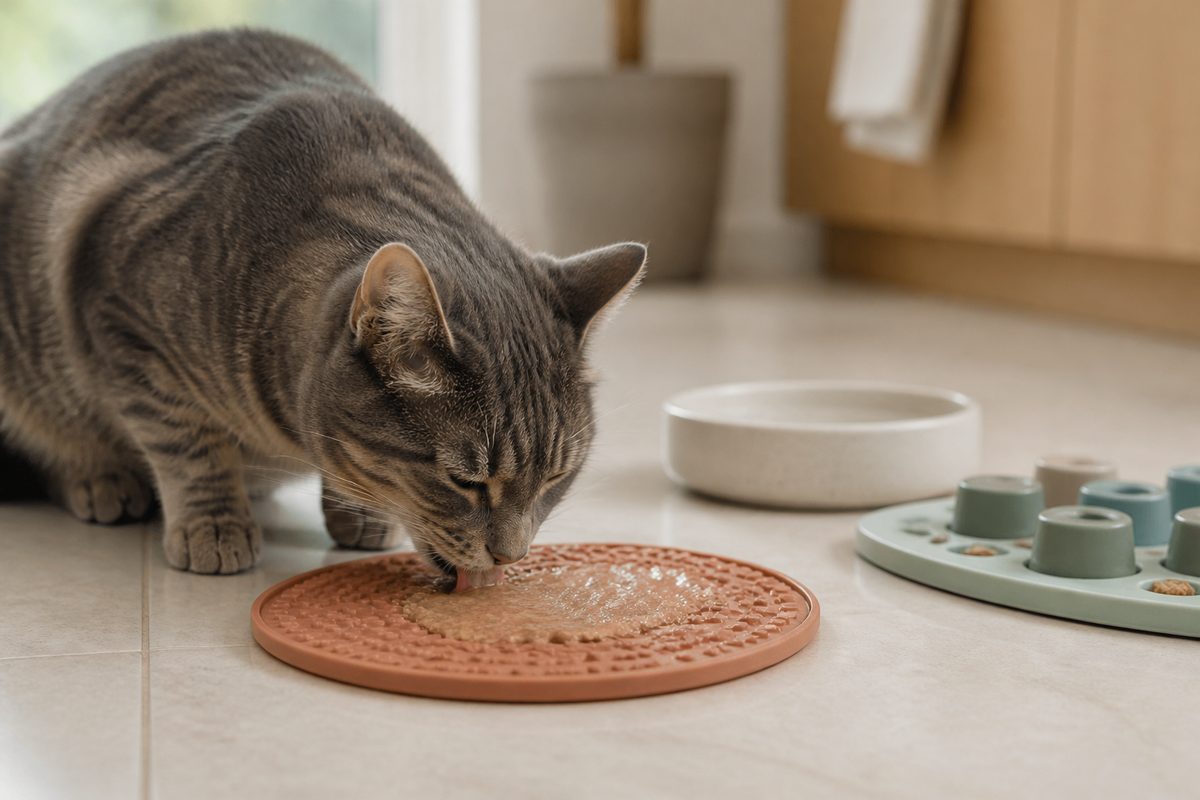
Search "slow feeder cat bowl" and you mostly get dog merchandise resized in the listing photo. We make dog bowls, so here is the honest version from the maker side: most dog slow feeder designs fail on cats - and the one product category that genuinely works for cats is not a bowl at all.
First: does your cat actually need this?
Fast eating is a dog story that got projected onto cats. The species-typical cat pattern is the opposite: many small meals - a wild cat eats 10-16 times a day. A cat that grazes calmly over the day is doing exactly what cats are built to do; no gadget needed.
Slow-feeding becomes a real goal in two situations: your cat bolts a wet meal whole and regurgitates it minutes later - the food comes up undigested, tower-shaped, usually within 15 minutes - or multi-cat competition has turned meals into a sprint. If either describes your household, keep reading; and loop in your vet if regurgitation is frequent, since that symptom has medical causes too.
Why dog slow feeders fail on cats - three mechanical reasons
We carved our maze for a Labrador's tongue and a full cup of kibble. Cats break that design three ways:
- Portion mismatch. A maze bowl's troughs are sized for dog portions. A cat's 30-gram wet meal spreads through the pattern so thin that the cat gives up licking and tips the bowl instead. The obstacle is engineered for a different animal's dinner.
- Whisker stress. Cats' whiskers are dense sensory organs; pressing them against raised ridges and deep walls at every bite is genuinely aversive - it is why cats drag food out of deep bowls to eat off the floor. A slow feeder built on tall ridges fights the cat's own hardware.
- Face geometry. Flat-faced breeds - Persian, Exotic, British Shorthair - cannot navigate tight mazes at all; they can barely reach the bottom of the pattern. Dog variety stops at size; cat variety includes skull shapes no maze accommodates.
Our dog-side ranking, the slow feeder bowl types compared, applies the same physics to dogs - and the honest answer for cats is that most of those types score worse, not better, on a cat's body.
What actually works: the lick mat, for wet food
The method that survives cat anatomy: spread wet food thin on a suction-down silicone lick mat and serve it - for extra slowdown - slightly chilled or lightly frozen. A meal that takes 30 seconds to gulp becomes 10-15 minutes of rasping, the flat-face problem disappears because the surface is flat, and there is no whisker contact to stress over.
The mechanics are identical to the dog version we documented in the lick mat guide and its toppings recipes: spread, suction to a clean dry surface, release after. The cat differences are real though:
- Fills: plain wet cat food, water-based cat broth with no onion or garlic in the ingredients (both are toxic to cats), or a ribbon of plain pumpkin puree - no pie filling, no xylitol-sweetened anything. Thin layers beat thick blobs for slowdown.
- Suction reality: cats bat at mounted food. Our mats' hold is rated for dogs leaning and pushing; a determined cat will learn to slide a mounted mat on some surfaces. Supervise first sessions; if it slides, serve the mat flat on the floor with one edge under a food dish - the texture still forces licking.
- Portion fit: one standard mat is a generous single wet meal spread thin - which makes the mat a portion-control tool too. In multi-cat homes you can see exactly what each cat ate, which no shared bowl offers.
Full disclosure, again: we sell the 2-pack suction mats as a dog product. Cat households buy them anyway because, mechanically, nothing about suction-and-lick is species-specific - but they ship with dog-shaped marketing, not cat certification. Use judgment and supervision.
The other two methods that work
Puzzle stations, sized for cats: the cat-native version of a slow bowl is a flat tray with shallow cups or rolling toys that release small amounts of dry food - it moves the challenge from the face to the paw, sidestepping whiskers and skull shape entirely. We make none of these; buy from cat brands, look for "whisker fatigue" and "shallow" in the listing, and skip anything deep or narrow.
Station splitting (no products required): twelve tiny meals beat one gadget. An automatic feeder dispensing 8-10 micro-portions across the day reproduces the grazing pattern cats actually want and ends the sprint problem in multi-cat homes. Sometimes the best slow feeder for a cat is a schedule.
If you insist on a bowl: the short sizing checklist
- Shallow, wide, flat-bottomed dish with a single low center bump - it slows the lap without wall contact.
- Dry food only. Wet food in ridges recreates the cleaning failure we describe in the materials guide, at cat scale, where it is unsolvable.
- One bowl per cat, in separate rooms where there is competition - a slow bowl cannot enforce peace.
- Skip the motorized fidget-spinner gadgets: most cats either ignore them or guard them, and neither outcome slows eating.
Bottom line: cats do not need dog hardware. They need wet food on a lickable flat surface, paws instead of faces, or a day divided into twelve bites - everything else in the "slow feeder cat bowl" aisle is a dog product wearing a fish graphic. And if you stock pet retail, note the gap on your shelf: our wholesale side is honest about being dog-everything today, so if you want to be the store that answers cat-mealtime questions, you are early - and we are listening.
Common questions
Can I use a dog slow feeder bowl for my cat?
Sometimes, but expect a low score. The maze that slows a Labrador baffles or annoys most cats: their portions are smaller, so food sits unreachable in the troughs; their faces are flatter; and deep ridged bowls press against whiskers, which cats find genuinely stressful. Shallow puzzle feeders designed for cats work where dog bowls fail.
Do cats actually need to eat slowly?
Less often than dogs, but some do. Cats that bolt wet food then regurgitate minutes later, or cats competing in multi-cat homes, benefit from slower delivery. A cat that grazes many small meals a day - the species-typical pattern - is already eating at a healthy pace and needs no gadget.
Is a lick mat better than a slow feeder bowl for cats?
For wet food, usually yes. A chilled or lightly frozen lick mat stretches a 30-second gulp into 10-15 minutes of licking, works at cat-appropriate portion sizes, and suits flat faces completely. It is the closest thing to a cat-native slow feeder.
What should never go on a cat's lick mat?
Anything with onion or garlic in the ingredients (toxic to cats), xylitol-sweetened products, and fatty human leftovers. Plain wet cat food, water-based cat broth with no onion or garlic, and plain pumpkin puree - not pie filling - are the reliable fills.
Does Mellow Munch sell cat products?
Yes, one so far: the Cat Slow Feeder Bowl, which uses 1.1-inch shallow ridges, an 8.7-inch whisker-clear rim and a 1.5-cup portion, built around cat anatomy rather than adapted from the dog maze. The suction lick mats are sold as a dog product and work fine for cats, but they are not cat-specific. Next cat SKUs get decided by what stockists and cat households actually ask for.
Recommended Gear: Dog Lick Mat (2-Pack) — Calming Feeding Mats
A 10-second dinner becomes a 15-minute ritual. Fill the grooves, stick it to the counter, watch the stress melt out of mealtime.