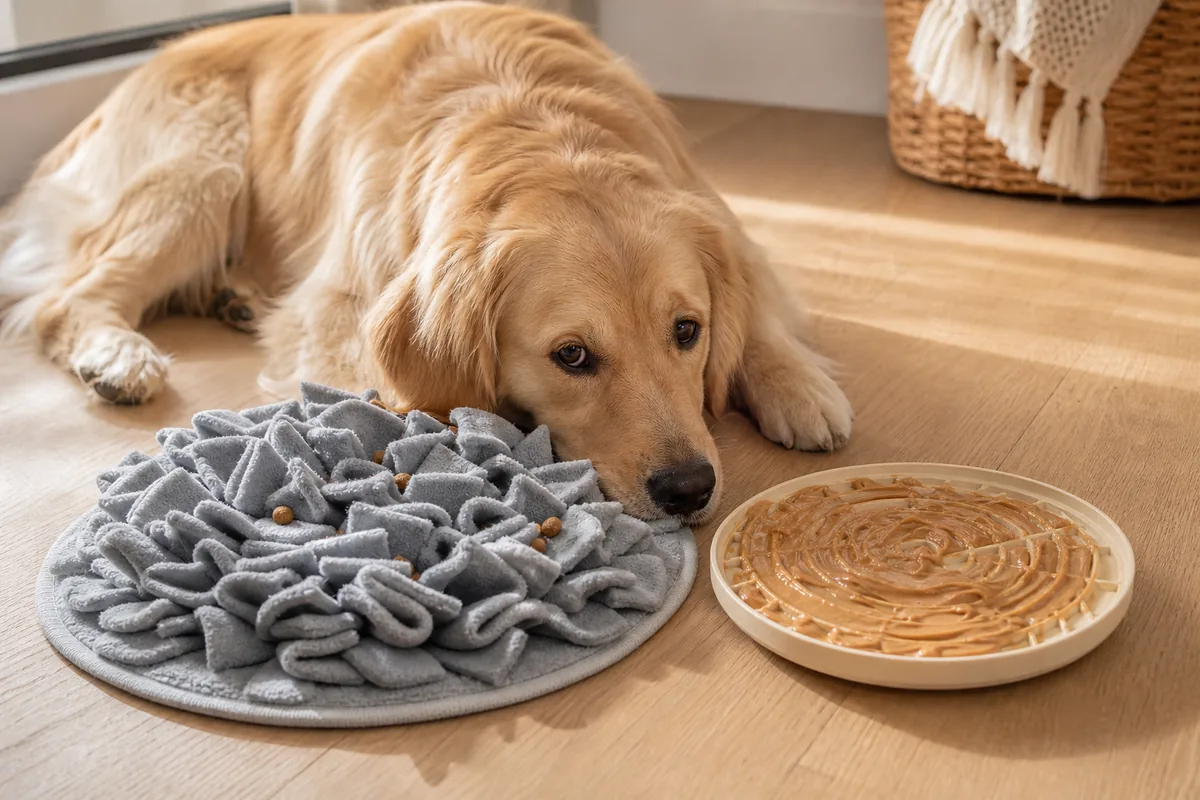
Anxious dogs tell you they are anxious long before you walk out the door. The pacing when you pick up your keys, the watching the hallway when the shoes come out, the tail tucked the moment the lock clicks. If you have lived with one, you know the pattern, and you also know the uncomfortable truth: the anxiety is not really about the leaving. It is about the state your dog is in when the leaving happens.
That is where enrichment tools come in. They do not fix separation anxiety the way a training plan does, and they do not sedate anything. What they do is change the dog's state in the window that matters — the ten or fifteen minutes before departure — so the dog closes the door busy, eating, and physically settled instead of wound up. For dogs with mild to moderate departure stress, that difference is often the whole game.
The window that matters: fifteen minutes before you leave
Dogs key onto pre-departure cues the same way anything conditioned does. Keys, shoes, the coat, the routine of checking the phone. After a few bad alone-experiences, those cues themselves raise arousal, so the dog is already stressed before the door has even opened. You cannot delete the cues — you have a life — but you can change what the cues are attached to. Instead of "shoes on, doom", the sequence becomes "shoes on, food hiding game starts".
The way to re-attach the cues is to make the pre-departure window a task. The dog that is nose-down in a snuffle mat when you pick up your keys is not tracking your movements the way the dog that is pacing the hallway is. The task is not a distraction in the dismissive sense; it is a job that uses the exact system — the nose — that dogs find genuinely absorbing.
Why nose work and licking lower arousal
A dog working a snuffle mat is doing something anatomically central: foraging. The nose is far more developed than the eyes, and a dog with its head in a pile of fleece finding kibble is focused, physically still, and expending the kind of mental energy that tires in a way a short walk does not. Trainers and behaviourists commonly prescribe scent and food-search tasks as part of calming protocols for this reason.
Licking works through a different door. The rhythmic act of licking is associated in dogs with comfort states — puppyhood, nursing, post-eating — and a lick mat gives the behaviour a safe target. Frozen, it becomes a long task: a mat smeared with peanut butter and frozen for a couple of hours keeps a dog occupied for twenty minutes or more. For a nervous dog that is about to be alone, twenty minutes of calm licking at the start of an absence is worth a great deal.
The toolkit, in the order most owners actually use it
The snuffle mat is the pre-departure work session. Scatter part of the meal — not extra food, part of the food — into the fleece and let the dog work it out in the ten or fifteen minutes before you go. It is the highest-engagement option, the one that changes the dog's posture from watching-you to working-the-floor. A mat with strips woven through a non-slip base survives daily use; a loose knot of towels is a fine place to start but not a permanent answer.
The frozen lick mat is the long-absence anchor. Where the snuffle mat wins the first fifteen minutes, a frozen lick mat carries the early part of the absence itself. Smeared with xylitol-free peanut butter, plain yogurt, or pumpkin puree and frozen, it keeps the dog occupied and calm while you are already out the door. It is the tool owners reach for on longer workdays. For the full setup — prep, freezing times, and the mistakes that make a mat useless — see our how to use a lick mat guide.
The slow feeder is for the meal that cannot wait. If your dog's stress shows up at every single feeding — gulping, barking at the bowl, the whole routine wound up — a maze-pattern slow feeder slows the meal and removes the frantic energy from it. It is not a calming tool in the emotional sense, but a calmer dog at dinner is a calmer dog at four o'clock.
A durable chew is for the longer absences — with a caveat. A solid rubber chew gives a dog that is alone for hours something to do with its mouth that is not the doorframe. But a chew is not a sedative and it is not supervision. For dogs that escalate when alone, a chew in an empty room is a placeholder, not a plan.
A plain, boring routine (boring on purpose)
The tools only work inside a routine, and the routine has one non-negotiable property: it must be boring. High-energy goodbyes teach the dog that departures are emotional events. So the sequence is deliberately flat.
Ten to fifteen minutes out: start the task — scatter the mat, set the frozen lick mat down. The dog's attention moves from your hands to the floor.
Exit window: shoes, keys, bag, normal pace. No crouching, no long goodbye speech, no visible distress. You are leaving the way you leave a room you will be back in.
Arrival: same flatness. No celebration for the first several minutes. The dog that is greeted like a hero at 5:02 p.m. has just learned that the absence was worth making a scene about. Give it ten minutes of nothing, then resume normal life.
Do this for a few weeks and the pre-departure cues stop recruiting anxiety and start recruiting the task. That re-attachment is the actual outcome you are building toward; the mats and bowls are just how you get the dog into the task.
Noise peaks: fireworks and storms
The same toolkit has a second season of use. Fireworks in July, storms in winter — noise spikes are when owners who never thought of their dog as anxious discover otherwise. A frozen lick mat while you are home, a room away from the windows, and steady background sound cover the routine side of noise stress.
Be clear about the limit: a dog that panics hard at noise — shaking, unable to settle, hiding for hours — is running a fear response deeper than mealtime tasks reach. That dog needs a desensitisation program with a trainer, and in some cases a conversation with the vet about whether medication makes the training possible. The lick mat is not the program; it is what keeps the dog occupied during it.
When it is more than a routine problem
One honest line has to be drawn, because anxious-dog content tends to blur it. If your dog destroys things that need cleanup, vocalises for long stretches, injures itself, or the length of time it can be alone is getting shorter instead of longer, you are not in "routine" territory. That is a separation-anxiety workup: a certified trainer or veterinary behaviourist, a plan built in small increments, and sometimes veterinary support alongside it.
Everything in this post is the layer on top of that work — the part that makes the daily margins calmer. For the dog that is just a bit keyed up when the keys come out, it may be all that is needed. For the dog that is truly suffering when alone, it is what makes the harder work easier, not a substitute for it.
Build the toolkit: the snuffle mat for the pre-departure session, the frozen lick mat for the long absence, and the slow feeder for calmer dinners. All three are food-safe, all three wash clean, and none of them require your dog to do anything it has not already evolved to want to do.
Common questions
What calms an anxious dog fastest?
A task that occupies the nose or the mouth: sniffing food out of a snuffle mat, licking a frozen lick mat, or working a slow feeder. Most dogs drop into a calmer, physically still state within a few minutes of working for food. Nothing calms a dog instantly, and tools should be expected to lower arousal over minutes, not seconds.
Do calming tools replace training for separation anxiety?
No. If your dog howls for long stretches, chews doorframes, or injures itself when alone, that is beyond what a mat can do — work with a certified trainer or a veterinary behaviourist on a real separation plan. Tools are the easy layer on top of that plan, not the plan itself.
Should I give my dog a task right before I leave?
For dogs that are mildly keyed up by departures, yes: start the task ten to fifteen minutes before you go so the dog is busy and physically settled when the door closes. Keep the exit itself plain — no long goodbyes, no visible distress — because the task only helps if the departure is calm.
What should I put on a lick mat for a nervous dog?
Xylitol-free peanut butter, plain Greek yogurt, pumpkin puree, or wet food. Freeze it for a couple of hours and the licking session stretches from five minutes to twenty or more, which is exactly what you want before a long absence. Always check any spread for xylitol — it is toxic to dogs.
When should I talk to a vet about my dog's anxiety?
When the behaviour is persistent and impairing: destruction that needs cleanup, vocalising that disturbs the house, drooling and pacing that do not settle, or a dog that simply cannot be left alone for an increasing length of time. A vet can rule out medical causes and, where appropriate, discuss whether medication alongside training is sensible.
Will these tools work for fireworks and storm noise?
They help with the general arousal, but noise phobia runs deeper than a mealtime task. A frozen lick mat while you are home, a safe room away from windows, and background sound cover the routine side. Dogs that panic hard at noise are candidates for a desensitisation program with a trainer, and sometimes veterinary support.
Recommended Gear: Snuffle Mat for Dogs — Interactive Foraging Mat
Dense polar fleece petals turn mealtime into a mental workout. 10 minutes of sniffing equals 1 hour of walking.