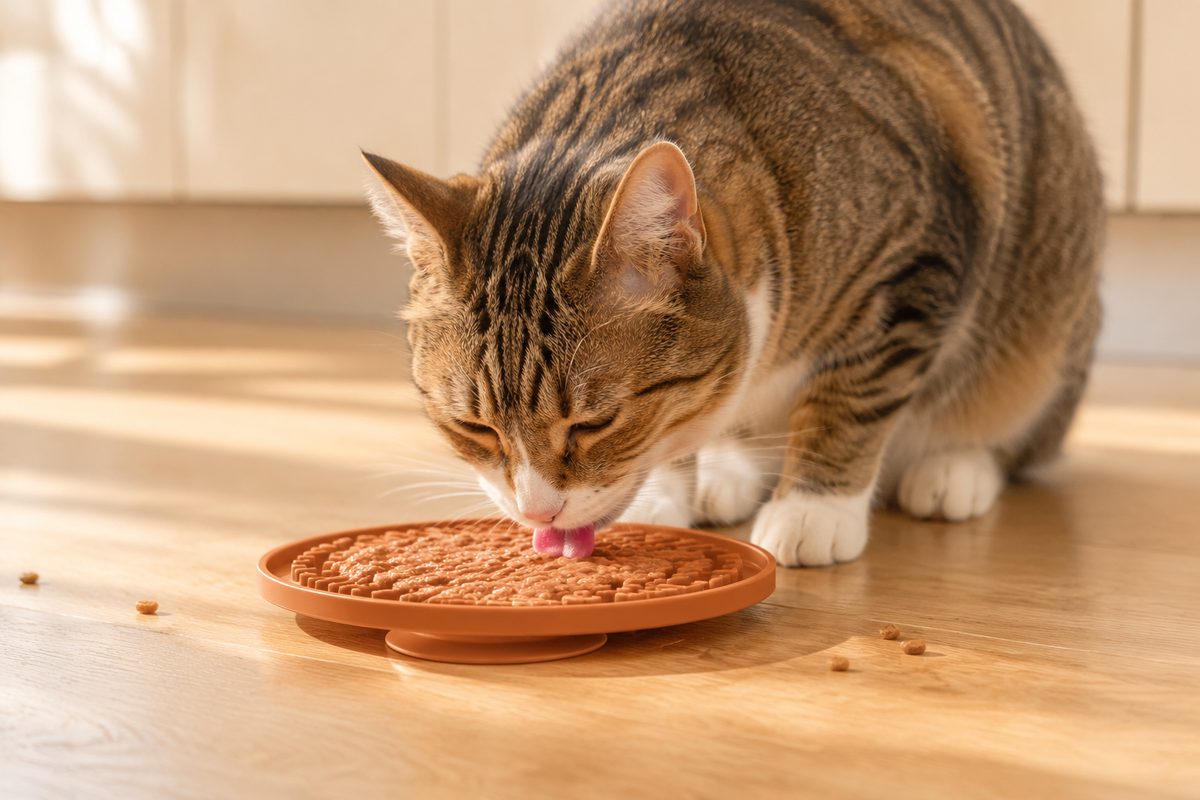
Short answer: yes, for wet food. A lick mat is the closest thing to a cat-native slow feeder - closer than any bowl on the market, including ours. But the parts that decide whether it works are what you spread on it and how you introduce it, not the mat itself.
Why a mat beats a slow feeder bowl for most cats
Dogs gulp because they are built for large, infrequent meals. Cats are the opposite: a wild cat eats ten to sixteen small meals a day, and a house cat grazing dry food through the afternoon is already eating at cat speed. So the dog-style slow feeder bowl is solving a problem most cats do not have - and creating new ones. We covered the bowl side properly in what actually works for slow-feeding a cat; here is the short version of why bowls lose.
Whisker stress. Deep, ridged bowls press against a cat's whiskers, and cats are measurably sensitive to that. A flat mat has no walls to press against.
Portion geometry. A dog maze is sized for two cups of kibble. A cat eats a quarter of that, and food that falls into the troughs of a dog bowl simply becomes unreachable.
Face shape. Flat feline faces do not reach into narrow channels the way a Labrador's muzzle does. A smear on a flat surface asks nothing of their anatomy.
What actually goes on a cat lick mat
This is where most cat lick mat advice goes wrong: it copies dog advice. Peanut butter, yoghurt, cream cheese - those are dog defaults, and none of them belong in a cat's bowl.
Reliable fills: plain wet cat food straight from the pouch; plain cooked chicken or whitefish, shredded; plain pumpkin puree (not pie filling); water-based cat broth with no onion and no garlic; a single-ingredient meat puree with no seasoning.
Never: anything containing onion or garlic (toxic to cats at small amounts), anything sweetened with xylitol - check the label on peanut butter brands especially - fatty human leftovers, and dairy if your cat is one of the many that do not tolerate it. Any change to what a cat eats is worth a word with your vet, particularly for cats with kidney or urinary history.
Introducing it in three sessions
Session one. A smear thin enough to see the grooves through it, on the floor where the cat already eats. Five minutes, then take it away - even if it is not finished. The goal is a first success, not a full meal.
Session two. Same food, slightly thicker layer. Most cats are now licking without hesitation; the ones that are not get another round of session one rather than a new flavour.
Session three. Introduce the freeze. A frozen mat stretches the same portion to twenty minutes or more, which is the version that earns its place on a hot afternoon or a vet-appointment morning.
Freezing, cleaning, and the suction question
A wet-food mat freezes solid in about two hours; a broth-based one takes longer because of the water content. Let it sit for two minutes before serving so the surface softens enough to lick.
Top-rack dishwasher is fine. By hand, hot water, a little dish soap and a soft brush through the grooves does the job. Silicone eventually holds smells - a warm soak with baking soda resets it, which is also why we do not recommend leaving a mat unwashed overnight.
The suction base matters more for cats than dogs, because cats lick sideways and push the mat across the floor as they go. A mat that skates ends up under the fridge.
When a lick mat is the wrong tool
The grazer. If your cat already eats small amounts through the day and holds a healthy weight, there is nothing to slow down. A mat is enrichment at that point, not treatment - fine to use, but do not expect a behaviour change.
The multi-cat household with a guarder. One mat and two cats creates a resource to defend. Separate stations, out of sight of each other, or skip it.
Frequent regurgitation. Food that comes back up undigested within minutes, repeated vomiting, weight loss or a sudden change in appetite are veterinary questions, not feeding-gadget questions. Get the cat checked before buying anything.
What we make, honestly
We sell a two-pack of suction lick mats as a dog product, and we are not going to pretend otherwise - the mat itself is not cat-specific. What transfers is the engineering: food-grade silicone, shallow grooves that hold a thin layer, freezer-safe, dishwasher-safe, and a suction base strong enough that a determined licker cannot walk it across the kitchen. Cat households already buy them for exactly this. Where we did go cat-specific is the bowl: the Cat Slow Feeder Bowl drops the maze ridges to 1.1 inches and opens the lip so a flat feline face can reach every groove.
If you are coming at this from the dog side, the mechanics are the same but the fills are not: how to use a lick mat for dogs covers freezing, layering and the peanut butter question in detail.
Common questions
Do cats actually use lick mats?
Most do, with one condition: the mat has to be paired with something the cat already wants to eat. A mat smeared with an unfamiliar paste gets sniffed and abandoned. Start with the wet food the cat already finishes, spread thin, and the licking behaviour appears on the first or second try.
Is peanut butter safe on a cat lick mat?
No - peanut butter is a dog default, not a cat food. Cats are obligate carnivores and gain nothing from it, and some peanut butter brands contain xylitol, which is toxic. Use plain wet cat food, plain cooked chicken or whitefish, or a water-based broth with no onion or garlic.
Can I use a dog lick mat for my cat?
Yes. The physical requirements are the same - food-grade silicone, shallow grooves, a suction base - and most dog mats are simply larger, which suits a cat fine. What does not transfer from dogs is the filling and the portion size.
How long should a cat stay on a lick mat?
A thin smear of wet food takes most cats five to fifteen minutes. That is the point: it turns a thirty-second gulp into a proper meal and gives an indoor cat something to do. Frozen mats last longer and are useful in hot weather.
Are silicone lick mats dishwasher safe?
Top-rack dishwasher safe, yes. For hand washing, hot water with a little dish soap and a soft brush through the grooves is enough. Silicone can hold smells over time - a soak in warm water with baking soda resets it.
Recommended Gear: Dog Lick Mat (2-Pack) — Calming Feeding Mats
A 10-second dinner becomes a 15-minute ritual. Fill the grooves, stick it to the counter, watch the stress melt out of mealtime.